


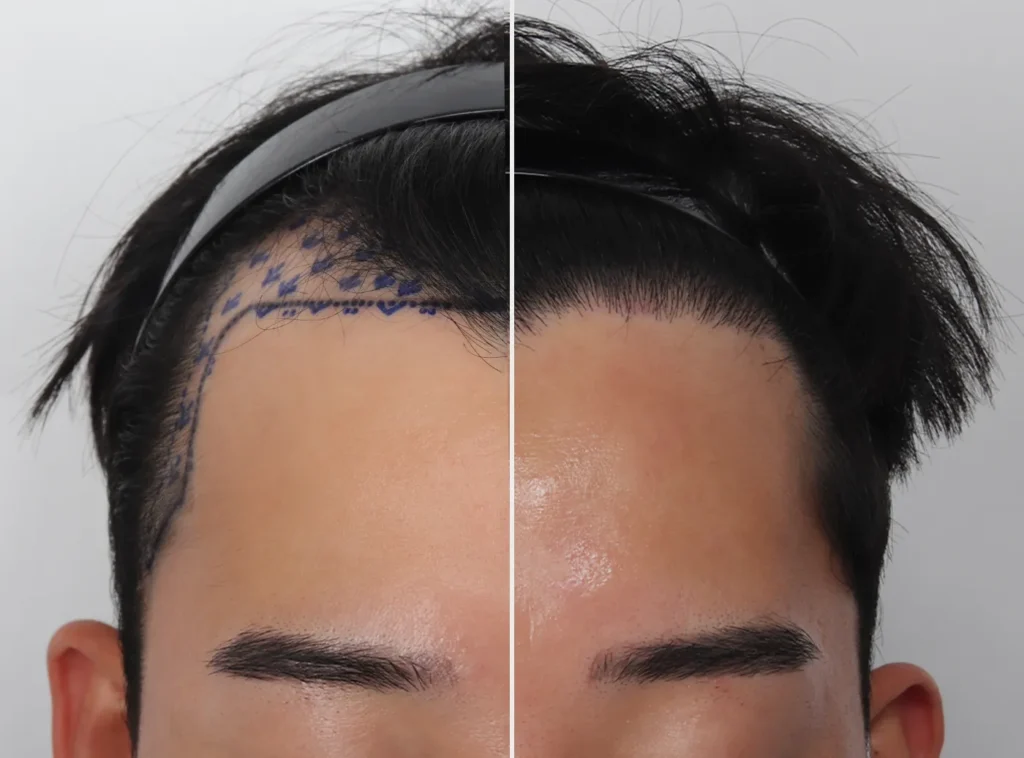
3,000-Hair Transplant Review: A Customized Approach for a Natural, Sharper Hairline
Patient: Mr. Jihoon Kim, age 36
For many patients, hair loss is not only a cosmetic concern but also an emotional one. At age 36, Mr. Jihoon Kim had been experiencing progressive hair loss that made his forehead appear wider and his crown look thinner. He also wanted a more defined facial impression to better suit his round face shape.
This case highlights how a carefully planned 3,000-hair transplant can improve both hair density and overall facial balance.
Patient Concerns and Initial Assessment
Mr. Kim visited the clinic after noticing continued recession in the frontal hairline and visible thinning at the crown.

During consultation, the focus was not only on the areas where hair loss had already progressed, but also on areas likely to worsen over the next 2 to 3 years. This is an important part of long-term planning, because a hair transplant can restore thinning areas, but it does not stop future hair loss on its own.

After detailed evaluation:
- The M-shaped recession had already lost follicles and was a strong candidate for transplantation.
- The crown area was thinned, but not completely bald.
Because of this difference, the treatment plan prioritized transplanting the frontal recession while managing the crown in a way that could improve thickness without unnecessary surgery. This approach can help patients achieve a better outcome while avoiding overtreatment.
Customized Hairline Design
A natural-looking result begins with a personalized design.
For Mr. Kim, the hairline was planned with several goals in mind:
- Creating balance between the eyebrow line and hairline
- Preserving left-right symmetry
- Avoiding an unnaturally straight or artificial frontal line
- Designing sharper angles and side contours to complement his round face shape
Rather than creating a flat, rigid line, the hairline was shaped with subtle irregularity so it would look natural from different angles and distances. In this case, the design also aimed to give Mr. Kim a more refined and sharper appearance overall.
Donor Area Planning
The donor area—typically the back of the scalp—must be managed carefully to preserve density and minimize visible scarring.
Before surgery, the team evaluated:
- Scalp elasticity
- Head shape
- Tension across the donor region
A three-dimensional donor design was then created to reduce tension on the incision line as much as possible. This is especially important in strip-harvest procedures, where excessive tension can widen a scar over time.
Follicle Harvesting and Graft Preparation
Once the donor design was finalized, follicle harvesting began.
This stage requires delicate handling, because follicles can be damaged if the surgical field is not well organized. Great care was taken to:
- Keep the operative area clearly separated
- Arrange the hair neatly during harvesting
- Prevent tangling or unnecessary trauma to the grafts
After harvesting, the follicles were dissected into transplantable grafts. At this stage, both surgeon technique and the experience of the graft-preparation team are critical. The goal is to separate follicles as precisely as possible while preserving the surrounding stem cell structures that support graft survival.
Donor Area Closure
To reduce the visibility of scarring, a specialized closure technique was used.
Because scar size is strongly affected by scalp tension, the donor area was closed using:
- 2- to 3-layer tension-distributing sutures
- Internal and external support
- Careful trimming of the skin edges for a more refined closure
This technique helps the scar remain as inconspicuous as possible while supporting proper healing.
Hair Transplantation Technique
The transplant itself was performed using an implanter pen.
Compared with the slit method, the implanter technique typically requires more time, cost, and manpower, but it offers more precise control over:
- Depth
- Direction
- Angle
- Density of placement
This precision is especially important when creating a natural frontal hairline.
To make 3,000 hairs appear fuller, the transplanted hairs were arranged strategically:
- Hairs were placed in an overlapping pattern to reduce visible empty spaces
- Finer hairs were positioned in the very front for softness
- Thicker hairs were placed slightly behind to create the appearance of volume
This distribution helps produce a result that looks both dense and natural.
Immediately After Surgery
Even after implantation is complete, the procedure is not truly finished.
Because many grafts are placed densely into a relatively small area, each implanted follicle must be checked carefully to make sure it has not shifted in position or angle. A final review was performed to confirm that the transplanted hairs were sitting properly.
A regenerative laser treatment was also provided immediately after surgery to support healing and improve graft survival.
Next-Day Follow-Up and Early Recovery
Mr. Kim returned to the clinic the next day for:
- Scalp shampooing
- Disinfection
- Examination of the transplant and donor areas
- Additional regenerative laser care
The first 48 hours after hair transplantation are especially important for graft survival. Early postoperative care during this period can play a meaningful role in both healing and graft take.
Because the procedure had been performed carefully, Mr. Kim’s recovery was already progressing well by the next day.
Early Patient Reaction
At his next-day checkup, Mr. Kim compared his before-and-after photos and was very pleased with the immediate change in his appearance. Seeing his excitement as he looked in the mirror and took photos was one of the most rewarding moments of the case.
The clinic also reassured him that follow-up would continue until the transplanted hair had fully grown in.
Before and After
This case showed visible improvement in the frontal hairline as early as the next day, with a cleaner frame to the face and a stronger overall image.

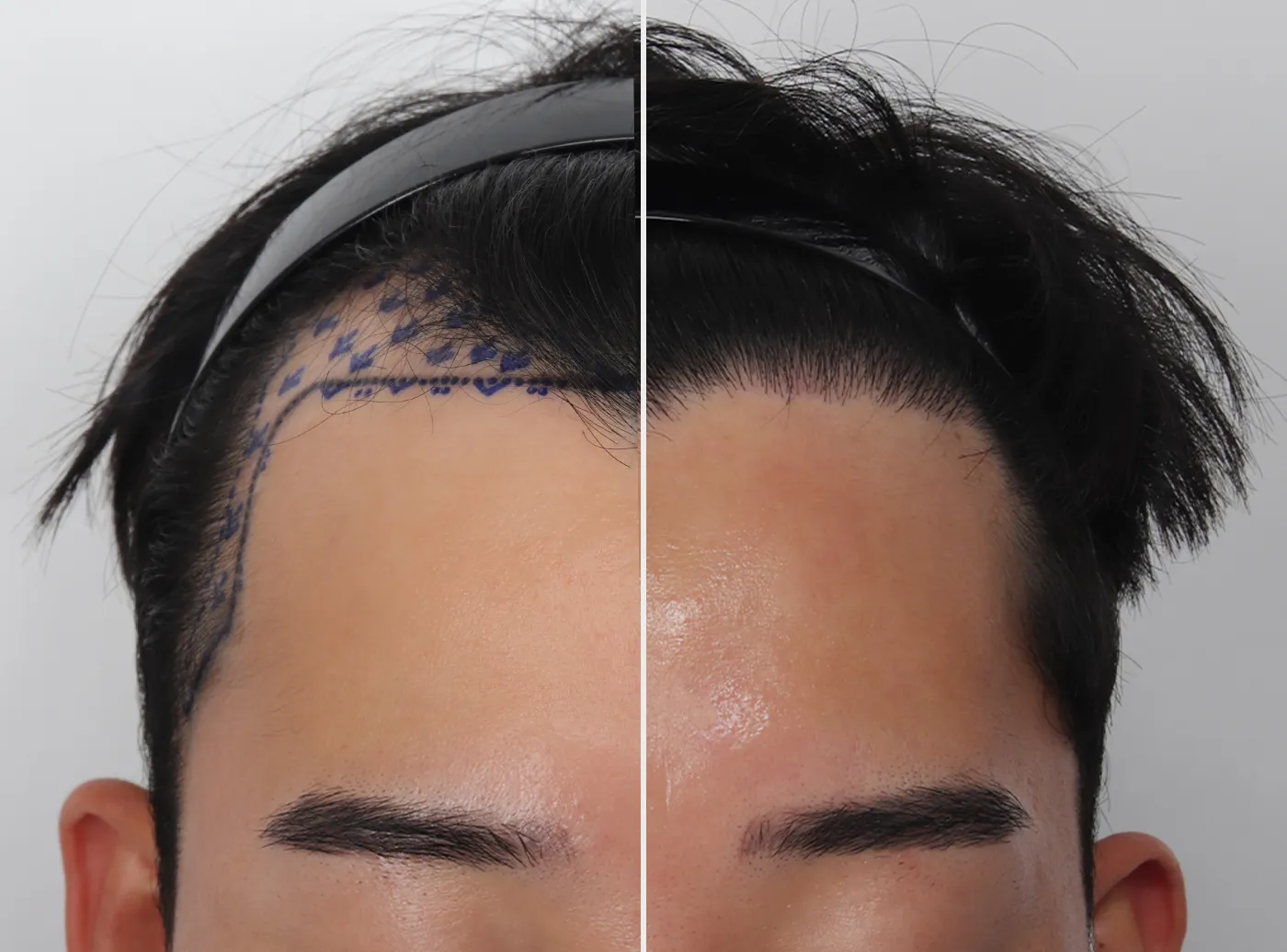
For patients considering hair restoration, this case demonstrates that successful outcomes depend on more than the number of hairs transplanted. The most important factors include:
- Accurate diagnosis
- Long-term hair loss planning
- Customized hairline design
- Precise graft handling
- Careful aftercare
Why This Matters for Medical Tourists
For international patients traveling for hair restoration, a well-organized process is essential. This case reflects several features many medical tourists look for:
- Detailed preoperative assessment
- Personalized design based on facial proportions
- Thoughtful planning for future hair loss
- Advanced implantation technique
- Structured next-day follow-up and recovery care
A successful hair transplant is not only about filling in empty areas—it is about creating a result that looks natural, suits the face, and remains sustainable over time.
Maxwell Hair Clinic
begin your consultation today
Consulting with Maxwell Hair Clinic is fast and simple. After you fill out the consultation form, one of our patient team members will reach out to you via email. Our initial online consultation is free of charge.
One-Day Treatment for International Patient at Maxwell Hair Clinic
We understand the diverse needs of our global clientele and strive to provide a seamless, comfortable experience for everyone. Our doctors have extensive experience working with different ethnicities and scalp types, ensuring each transplant is tailored to the individual’s unique hair characteristics for the best possible results.


Our Process for International Patients
- Share Your Information: Send us your details along with clear photos of your areas of concern. This helps our medical team understand your needs from the start.
- Online Medical Review & Personalized Quote: Our doctor will carefully assess your photos and provide an online consultation. You’ll receive an accurate, personalized treatment plan and quote based on your hair and scalp condition.
- Schedule Your Procedure: Once you’re ready, book your surgery on a date that works for you. Our team will guide you through the steps to prepare for your visit.
- Travel to Korea With Full Support: Our international patient coordinators will assist you throughout your journey—ensuring a smooth experience with no language barriers.
- One-Day Surgery: Your hair transplant procedure will be completed in just one day using our advanced techniques.
- Next-Day Shampoo & Follow-Up: Return to the clinic the following day for a gentle shampoo session and a post-operative checkup with the doctor.
- Virtual Follow-Up Appointments: We stay connected with you throughout your recovery, with virtual check-ins at 1 month, 6 months, and 12 months.
- Enjoy Your Results: Watch your new hair grow and enjoy your final results over the coming months.
Maxwell Hair Clinic
What to Expect as an International Patient
1
Full Online Consultation
Begin your journey with a simple online consultation. Our consultants will guide you through creating your treatment plan and scheduling your procedure.
2
Travel to Korea
We can provide assistance in arranging an airport pickup. This service costs $80. If you wish to travel independently, you can take the airport bus, which costs $15.
3
Cost Consideration for Travel
– Accommodation: Typically $50-$200 per day.
– Meals: $10~$20 per meal on average.
– Flights: Check a few months in advance to find the best deal.
4
Meet Your Doctor
Our consultants and medical team will welcome you to our facility for your final diagnosis and personalized hairline design.
5
Treatment Day
We will provide you with a personal translator for the duration. After the procedure, we will assist with your after care and medicine pickup, and see you off to your accommodation.
6
Check Up, Relax, Fly Home
The following day, you will have a check-up appointment. Afterwards, you are free to enjoy your time in Korea. If needed, we can assist with airport drop-off arrangements for your departure.
Superior Results
Maxwell Guarantee


Note: This article was translated and published from the original with consent from the author.